Suitable inputs or applications
- Agricultural residues
- Napier grass
- Bamboo and wood residues
- Coconut shell
- Rice husk
- Sugarcane and horticultural residues
- Selected forestry residues
Develop biochar projects around appropriate feedstock, controlled pyrolysis, product quality, market demand and credible carbon accounting.
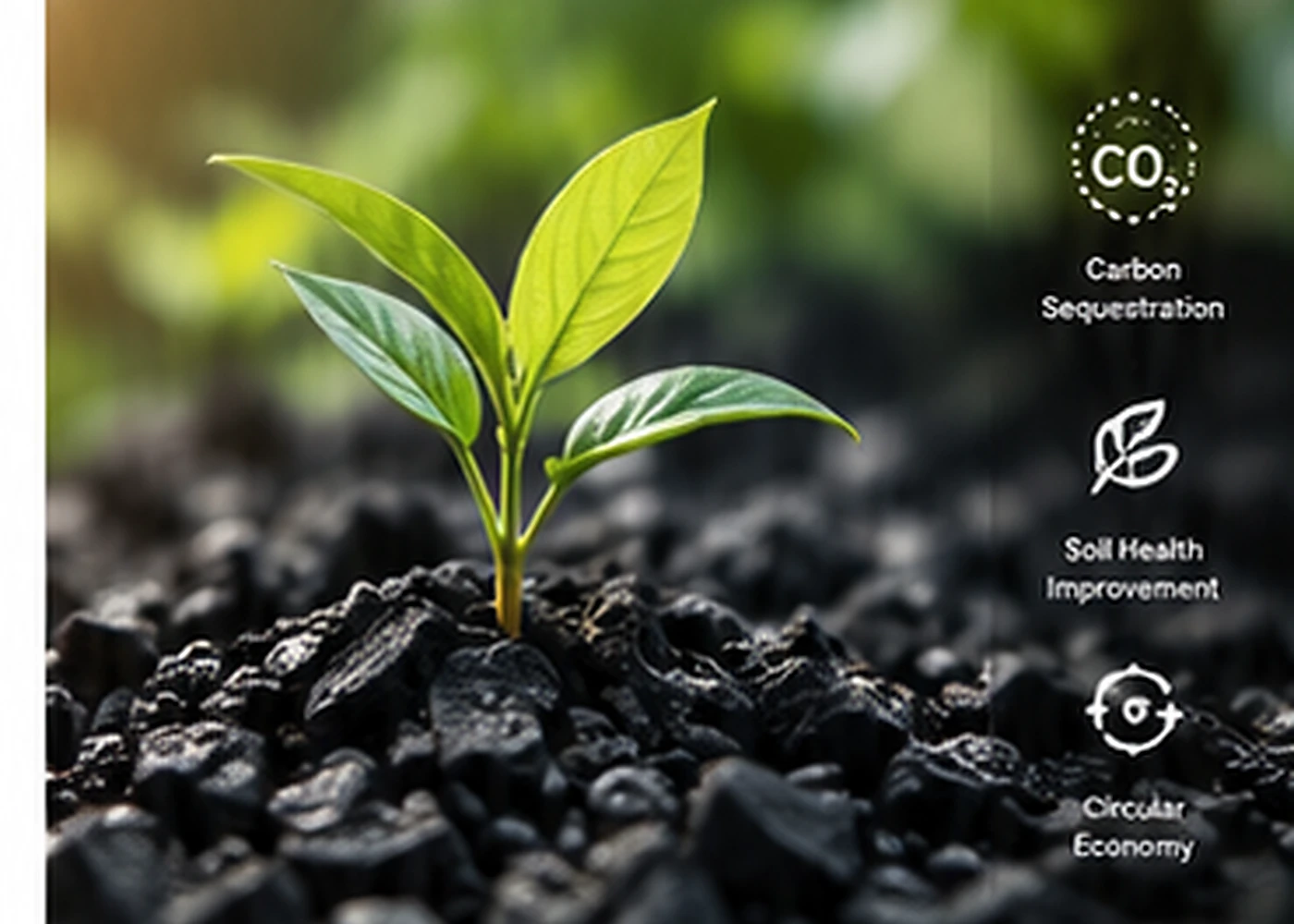
Biochar is a stable, carbon-rich material produced by heating suitable biomass under limited-oxygen conditions through pyrolysis. Its properties vary materially with feedstock and production conditions.
Actual outcomes depend on input quality, process configuration, operation, product quality and local conditions.
Stable carbon may support durable carbon-removal pathways when methodology requirements are met.
Appropriately produced and applied biochar may improve soil structure, water retention and nutrient management.
Agricultural and forestry residues can be converted into value-added products rather than burned or wasted.
Biochar can support soil-amendment, compost, filtration and specialised material applications.
Projects may create local aggregation, processing, application and distribution opportunities.
Biomass resources, heat, biochar products and environmental data can be integrated into a circular model.
A project cannot be responsibly configured without the following information.
The final scope is defined after preliminary assessment and may involve specialist implementation partners.
Included when relevant to the agreed project-development mandate.
Included when relevant to the agreed project-development mandate.
Included when relevant to the agreed project-development mandate.
Included when relevant to the agreed project-development mandate.
Included when relevant to the agreed project-development mandate.
Included when relevant to the agreed project-development mandate.
Included when relevant to the agreed project-development mandate.
Included when relevant to the agreed project-development mandate.
Included when relevant to the agreed project-development mandate.
Included when relevant to the agreed project-development mandate.
Included when relevant to the agreed project-development mandate.
Included when relevant to the agreed project-development mandate.
Share technical and commercial information for preliminary review.